
What is EFT Tapping?
Emotional Freedom Techniques (EFT) — also called Tapping — is an evidence-based stress regulation tool. It combines gentle fingertip tapping on acupressure points with focused attention on a feeling or situation. It works bottom-up: calming the body first, which then allows the mind to follow.
🧠 What you say or think
A setup statement naming your feeling, followed by short reminder phrases at each point
🤲 Where you tap
Specific acupoints on the face and upper body, shown to calm the brain's stress response
⚡ Why it works
Tapping sends safety signals to the amygdala — the brain's alarm centre — interrupting the stress loop
📋 The evidence
Clinical EFT is tested in research trials worldwide by Dr Stapleton and others — it is the protocol used here
Why the Evidence Matters
Research by Dr Peta Stapleton (Bond University, Australia) and others shows that EFT produces measurable physiological and psychological change:
Average reduction in cortisol after EFT sessions
SUD scale reliably tracks distress before & after
Typical session length for in-the-moment relief
Used in schools, hospitals & communities worldwide
EFT is gaining scientific support and is accepted as a legitimate psychological technique. It is not a replacement for professional mental health treatment. Always seek professional advice for serious mental health concerns.
How Stress Shows Up for Teachers
Teaching is one of the highest-stress professions. EFT works best when you are very specific about your experience. Here are common teacher stress patterns:
📋 Workload Overwhelm
Too much to do, admin pressure, planning late into the evening
👁️ Performance Pressure
Observations, Ofsted, expectations, fear of not being enough
💔 Compassion Fatigue
Absorbing students' emotional pain, carrying their stress home
⏰ No Space for Self
No lunch break, no transition time, always "on"
🌙 Night-Time Activation
Mind racing, replaying the day, unable to switch off
🔄 Chronic Background Stress
Low-grade tension that has become the new normal
The 5 Steps
"Even though I [describe your feeling], I deeply and completely accept myself."
Name your feeling or issue. Rate your distress 0–10 on the SUD scale. Trust your gut.
Say it 3× while tapping the Side of Hand point. The first part names the truth; the second offers self-acceptance.
Say a short reminder phrase at each point (one round). Stay with the feeling.
Take a breath. Rate your distress again 0–10.
Keep tapping rounds until SUD reaches 0 or 1.
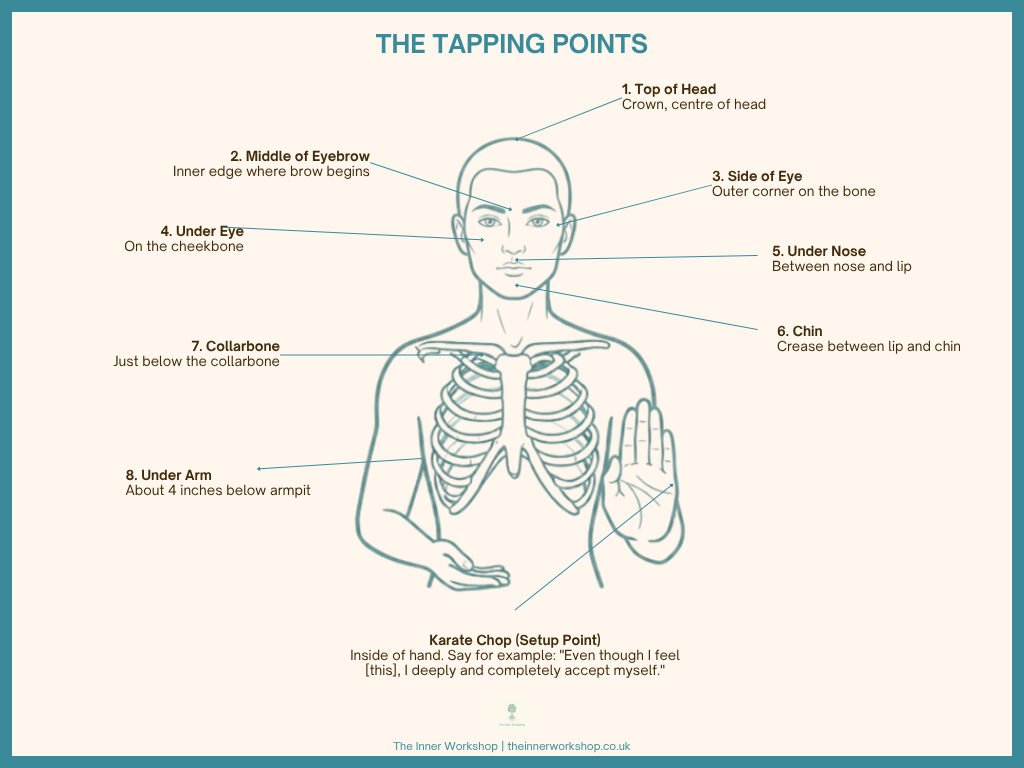
The Tapping Points
Tap with two fingers (index + middle) with firm but comfortable pressure. You don't need to count — tap for as long as it takes to say your phrase at each point.
Teacher-Specific Tapping Scripts
Tapping works best when the words match your experience. Use these as starting points — adapt freely to what feels true for you.
📋 Workload Overwhelm
"Even though there is too much to do and I don't know how I'll get through it, I accept how overwhelmed I feel right now."
Head: "All this overwhelm" · Eyebrow: "All this pressure" · Side of Eye: "Too much to do" · Under Eye: "My mind won't slow down" · Collarbone: "Tight chest" · Under Arm: "I'm doing my best"
👁️ Observation / Inspection Anxiety
"Even though I feel sick with anxiety about being observed and judged, I accept this is how I feel right now."
Head: "This anticipation" · Eyebrow: "This dread" · Side of Eye: "Fear of being judged" · Under Eye: "What if it goes wrong?" · Nose: "All this pressure" · Chin: "What will they think?" · Collarbone: "Carrying this pressure" · Under Arm: "I'm doing my best"
💔 Compassion Fatigue
"Even though I'm exhausted from absorbing everyone else's stress and there's no space left for me, I accept how depleted I feel."
Head: "All this depletion" · Eyebrow: "This exhaustion" · Side of Eye: "No time for me" · Under Eye: "This emotional load" · Nose: "Giving so much" · Chin: "Nothing left for me" · Collarbone: "Carrying everyone" · Under Arm: "I deserve to rest"
🌙 Can't Switch Off at Night
"Even though my mind keeps replaying today and I can't rest even though I'm exhausted, I accept this stress response in my body."
Head: "Holding onto the day" · Eyebrow: "Racing mind" · Side of Eye: "Can't switch off" · Under Eye: "Still on alert" · Nose: "Replaying everything" · Chin: "Won't let me rest" · Collarbone: "Wired but tired" · Under Arm: "I can let today go"
3 Ways to Use Tapping in School
Tap on body sensations only (tight chest, jaw, stomach) to bring immediate calm before a lesson or meeting. No words needed.
Tap each point while just saying "breathe" or "relax". Introduces physiological calm quickly — great for breaks between lessons.
Use tapping to understand why certain situations trigger a stress response. Explore earlier memories where you first learnt this pattern.
Using EFT to Support Students
EFT is being welcomed into schools globally because it can be learned by everyone — including children — due to its gentle, non-invasive approach.
🏫 In the Classroom
- Brief "tap and breathe" as a class settling routine
- Before tests or presentations to reduce anxiety
- After conflict to help students regulate
- Mindful moment — tap on "I feel nervous" openly
👤 With Individual Students
- Teach the points as a self-regulation tool
- For exam anxiety: "Even though I'm terrified of this test..."
- Social stress, friendship difficulties, belonging fears
- After upsetting incidents before returning to learning
🗣️ Age-Appropriate Language
- Young children: "the worry spots" or "the calm-down taps"
- Teens: frame as brain science — "we're telling your amygdala it's safe"
- Normalise it — "let's all do it together"
Important Boundaries
- EFT for students is supportive self-regulation, not therapy
- Never pressure a student to tap on traumatic material alone
- Refer to SENCO/pastoral lead for complex emotional needs
- Always obtain appropriate consent and follow school safeguarding policy
Common Questions
Does it have to be perfect?
No. There is no "wrong" EFT. Your intention matters most. Research shows benefit even when tapping varies from protocol.
What if stress comes back?
Very common — not a failure. Stress has layers. View tapping as a practice, not a one-off fix. Each round sends a safety signal.
What if I feel emotional?
Keep tapping. Slow your breathing. Emotional release is normal — it means the stress response is softening. You can also shift to: "Right now I am safe."
I don't know why I'm stressed.
EFT works even when stress is vague. Try: "This unknown tension" or "My body feels on edge and I don't know why." Clarity often comes after.
Can I tap discreetly?
Yes. In a staffroom or meeting, tap on collar, hand, or knee points. Even one point with a breath can help. Use what's available.
How often should I tap?
Consistency matters more than duration. 5–10 minutes daily is ideal. Even a brief "tap and breathe" each day keeps your system regulated.
Stay Connected
Join the teacher community for follow-up resources, practical EFT tips and monthly online tapping sessions.
Your details are kept private and never shared. Unsubscribe any time.
EFT content informed by Dr Peta Stapleton's clinical EFT research and the EFT & Mindfulness Centre, UK.
This page is for informational purposes only and is not a substitute for professional psychological or medical advice.
If you are experiencing a mental health crisis, please contact your GP or call Samaritans: 116 123.
Support available for:
- ✓ Teacher stress and burnout
- ✓ Workload overwhelm
- ✓ Observation anxiety
- ✓ Compassion fatigue
- ✓ Can't switch off at night
- ✓ Classroom wellbeing tools
- ✓ Supporting pupil mental health
- ✓ CPD presentations
Book a 1:1 Session
Individual EFT or RTT sessions tailored specifically to the pressures of teaching.
Book a Discovery Call